FTP and Critical Power
FTP from a test or your best efforts, labelled as tested, entered or estimated, plus Critical Power and W' from your maximal efforts.

AI-generated image
For Cyclists
Connect ride history, recovery and event goals. Review FTP, Critical Power, training load and form without reducing the rider to a single score, whether you are preparing for a sportive, the Peak District or your first race.
One connected view
FTP from a test or your best efforts, labelled as tested, entered or estimated, plus Critical Power and W' from your maximal efforts.
Training Stress Score, fitness (CTL), fatigue (ATL), form (TSB) and ramp rate, with the formulas published.
Inspect duration, distance, elevation, intensity and activity-level analysis.
Plan a route around the prescribed workout and target duration, with distance, climbing and a candidate interval segment.
In the app
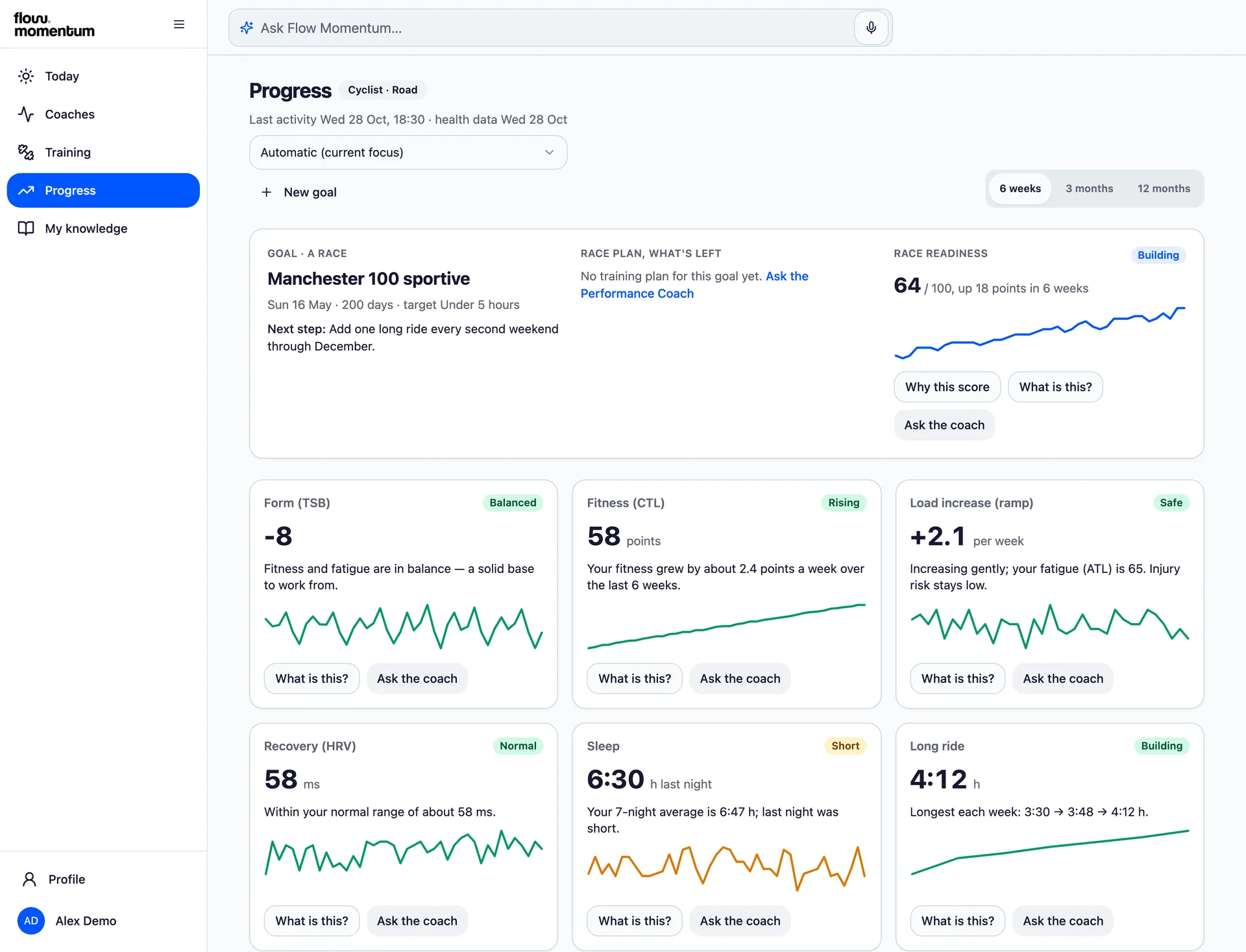
Race readiness, form, fitness, ramp rate, recovery and your longest ride each week sit on one page, each with a plain-language reading and a way to ask the coach about it.
What it can organise
What it supports
Current limits
From a 20-minute test (× 0.95), a 60-minute effort or a ramp test, or from a value you enter. Each FTP is labelled as tested, entered or estimated, and the formulas and sources are published in our calculations note.
Flow Momentum shows fitness (CTL), fatigue (ATL), form (TSB) and ramp rate together, and reads form in bands from fresh to overreached. The bands are a guide, not a rule of physiology, so they support your judgement rather than replace it.
Yes. Garmin is a supported connection, and you can upload FIT, GPX or TCX files from an indoor trainer or other devices. Strava access is currently limited.
Yes, if you invite them. You choose which performance and nutrition context they can see, private conversations stay private, and you can revoke access at any time.
Flow Momentum supports training and wellness decisions from the data available. It does not diagnose illness or injury, replace a clinician, or guarantee an outcome. Missing or stale inputs are shown as unavailable rather than invented.